Fine-tuning the MACE foundation model for Mg-Ca metallic glasses
Independent Researcher · Co-I, PARAM Rudra GPU grant · 2026 to present
- Training data. I built a 2,000-structure DFT training set (Quantum ESPRESSO) spanning crystalline, liquid, supercooled and glassy Mg-Ca, with an active-learning round aimed at the model's errors.
- DFT workflow. I designed the DFT convergence protocol and an automated SLURM workflow for hundreds of calculations, saving about 1,100 CPU node-hours.
- GPU deployment. MACE runs in LAMMPS on multi-node A100 GPUs (libtorch, Kokkos, CUDA), validated against ASE. It reaches 96% weak-scaling efficiency on 8 nodes, and memory tuning gave up to 3.3× throughput.
- Profiling and debugging. I profiled with Nsight Systems and traced a multi-GPU crash in the LAMMPS Kokkos ML-IAP interface to its root cause, documented for upstream.
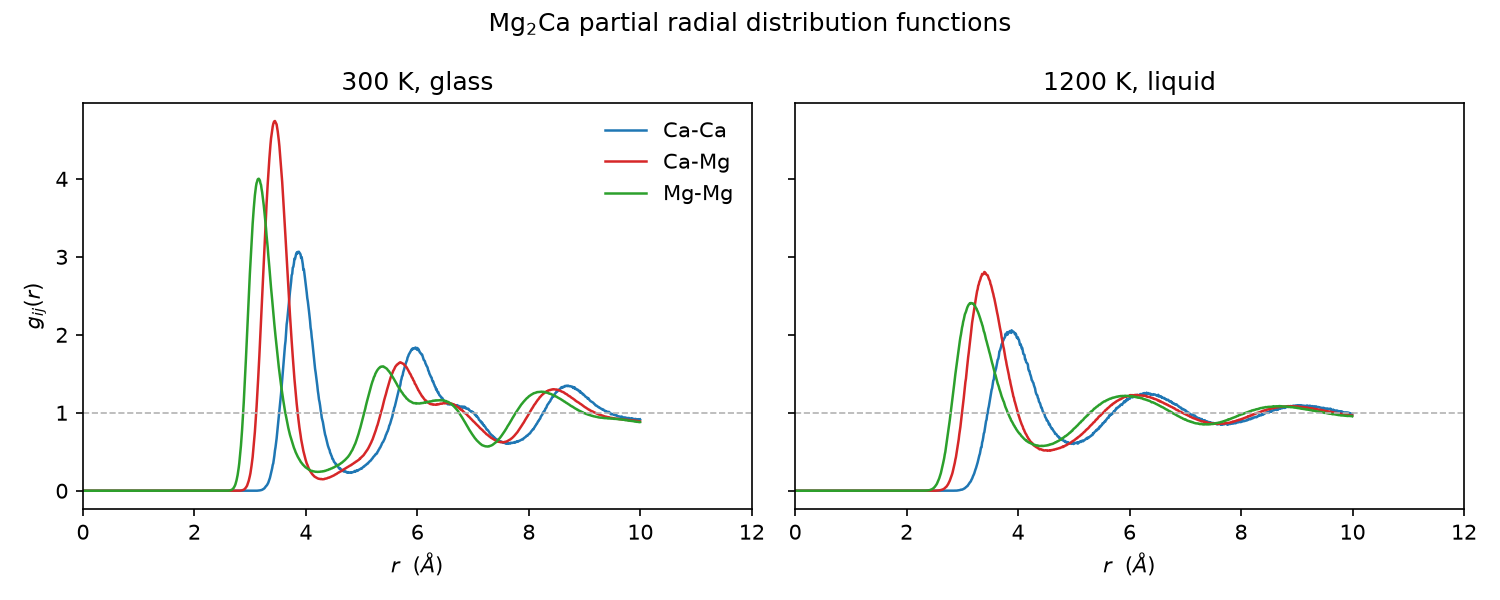
- Physics validation. Zero-shot MACE captures glass local structure that the classical 2NN-MEAM potential misses: a Mg/Ca icosahedral-centre ratio of 3.3 against 1.0, with experiment at 5.6.
- Next. Completion is expected in November 2026, with a public release of the fine-tuned MLIP and a journal publication to follow.